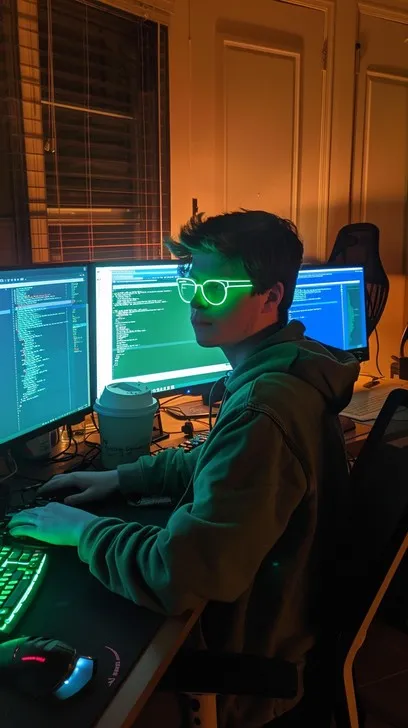
Side Hustle After Sundown: How Night Owl Developers Built Real Businesses on Stolen Hours

Photo: Flcikr user: perzon seo, CC BY 2.0, via Wikimedia Commons
The conventional startup story goes something like this: quit your job, raise a seed round, rent a desk at a co-working space in San Francisco or Austin, and grind until something sticks. It's a well-worn path, and it works for some people.
But there's another story that gets told a lot less often — the one about the developer in suburban Ohio who built a $200K ARR SaaS product entirely between 10 PM and 2 AM, while keeping their day job. Or the freelancer in Atlanta who landed three long-term European clients specifically because she was available during hours when every other US-based developer was asleep.
These aren't flukes. They're a pattern. And it's worth understanding why.
The Structural Advantage Nobody Talks About
Here's something the hustle culture crowd tends to overlook: building a business during unconventional hours isn't just about squeezing in more time. It changes the quality of the time you have.
Daytime development, especially in a traditional job context, is constantly interrupted. Slack notifications, meetings, someone stopping by your desk, a quick question that turns into a 45-minute discussion. Research consistently shows that it takes an average of 23 minutes to fully regain focus after an interruption. If you're getting interrupted five or six times a day, you're losing hours of real productivity before you even account for lunch.
Night sessions don't have that problem. Your phone isn't buzzing. Nobody's emailing you at midnight expecting a response in five minutes. The cognitive overhead of managing other people's urgency simply disappears. What's left is you, your problem, and an unbroken stretch of time to actually solve it.
For developers building something on the side, that uninterrupted focus is a genuine competitive edge — not a consolation prize for working weird hours.
Timezone Arbitrage Is a Real Business Strategy
One angle that comes up repeatedly among night owl freelancers is timezone flexibility. The US spans six time zones, but the global client market doesn't stop at the coasts.
Developers who work late US time are naturally available during business hours in Europe. A midnight session in Chicago lines up with early morning in London and mid-morning in Berlin. For freelancers targeting European clients — who often find it genuinely difficult to find responsive US-based developers in their working hours — this is a meaningful differentiator.
Marcus, a freelance developer based in Nashville, built his entire client base around this idea. "I was upfront with every European prospect: I work US nights, which means I'm basically on your schedule," he explained. "I had faster response times than local developers they'd worked with. That alone closed deals."
The same logic applies in reverse for developers targeting clients in Asia-Pacific. Late US nights are business hours in Tokyo and Sydney. The world doesn't run on Eastern Time, and developers who embrace that reality have access to a much bigger market than those who don't.
The Bootstrapper's Edge
There's a particular type of founder who thrives in the nocturnal development model: the bootstrapper. Someone building a product without outside investment, who needs to stretch every dollar and every hour as far as it can go.
When you're not accountable to investors or a board, you get to define your own operating rhythm. You don't have to perform productivity during business hours. You can build when you're actually at your best, ship when the code is actually ready, and grow at a pace that makes sense for your life.
Jamie, who built a niche project management tool for architecture firms out of her apartment in Denver, described her early days like this: "I had a full-time design job during the day. Every night from 9 PM to 1 AM was product time. No meetings, no distractions, just building. It took two years, but I launched with zero debt and paying customers on day one."
That's not a story about grinding yourself into the ground. It's a story about finding a sustainable tempo and sticking to it. The night hours were protected time — structurally defended against the chaos of the day.
The Real Costs (Because There Are Real Costs)
It would be dishonest to write this piece without acknowledging what the nocturnal business model actually takes out of you.
Sleep debt is real and cumulative. If you're consistently getting six hours or less, you're not operating at full capacity — you're just adapted to feeling that way. The cognitive deficits are there even when you don't notice them. Over time, chronic sleep restriction affects memory consolidation, emotional regulation, and decision-making in ways that can quietly undermine the very work you're trying to protect.
Relationships take a hit too. Building a business at night means those hours aren't available for a partner, kids, friends, or just decompressing. Some people manage this fine. Others don't, and the business succeeds while something else quietly falls apart.
And there's a specific kind of loneliness that comes with building something in the dark while the rest of your social circle has no idea what you're working on. It can be motivating and isolating in equal measure.
The developers who sustain this lifestyle long-term tend to share a few common practices: they're protective of at least one or two nights per week as genuine rest, they're honest with the people in their lives about what they're doing and why, and they've built some kind of accountability — a Discord community, a weekly check-in with another indie developer, something that keeps the work from feeling completely invisible.
Building a Business on Borrowed Hours
The broader point here isn't that night owl development is some secret hack that guarantees success. It's that the traditional model of building a business — full-time commitment, conventional hours, visible hustle — is one model among many, and it's not the right one for everyone.
For developers who do their best work after sundown, who have day jobs they're not ready to leave, who want to compete globally without a co-working space or a pitch deck, the late-night model isn't a compromise. It's a strategy.
The companies built this way are quieter than the ones that get TechCrunch coverage. They don't raise rounds or ring bells on trading floors. But they're profitable, sustainable, and built by people who figured out how to make unconventional hours work in their favor.
That's not a small thing. That's actually the whole game.