Night Owl or Sleep-Deprived Fool? How to Tell If Your Midnight Code Is Actually Good
Photo: Billy382, Public domain, via Wikimedia Commons
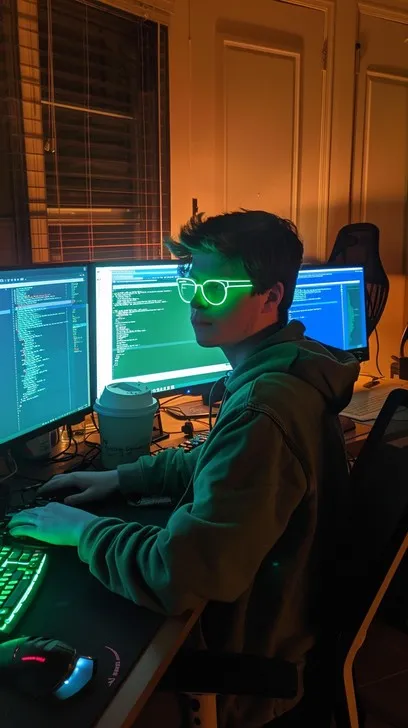
There's a specific kind of confidence that hits around 2 AM. The house is quiet, your second cup of coffee is halfway gone, and the code is just flowing. You're in the zone. You feel like you could rewrite the entire backend before sunrise.
But here's the uncomfortable question nobody asks until morning: is that confidence earned, or is it your prefrontal cortex slowly going offline?
The answer is genuinely complicated — and it matters a lot if you're serious about building things that last.
What's Actually Happening to Your Brain After Midnight
Let's talk neuroscience for a second, because it explains a lot.
Your prefrontal cortex — the part of your brain responsible for critical thinking, error detection, and long-term planning — starts losing steam as sleep pressure builds. For most people in the US, that pressure really kicks in somewhere between midnight and 2 AM, depending on when they woke up.
At the same time, something interesting happens with dopamine. Late-night focus can trigger a kind of tunnel vision that feels remarkably like flow state. Distractions fall away. Your inner critic quiets down. You stop second-guessing every decision.
The problem is that inner critic? It's actually useful. It's the part of you that notices when an abstraction is leaking, when a naming convention is inconsistent, or when you're building a clever solution to the wrong problem entirely.
So yes — you can be simultaneously more focused and more likely to make bad architectural decisions. Welcome to the 2 AM paradox.
Not All Code Is Created Equal at Midnight
Here's where it gets practical. The type of task you're working on matters enormously when it comes to late-night quality.
Debugging is where night owls genuinely shine. When you're chasing a specific bug — a race condition, a weird API response, an off-by-one error — the narrowed focus that comes with late-night fatigue is actually an asset. You're not distracted by the big picture. You're locked in on this problem, this stack trace, this line. The quiet helps, the tunnel vision helps, and honestly, the stubbornness that comes with being tired helps too. You're not giving up.
Refactoring is a mixed bag. Small, well-scoped refactors — renaming variables for clarity, extracting a repeated block into a helper function — can go fine at midnight. But big structural refactors? The kind where you're rethinking how modules communicate or untangling years of spaghetti? That's dangerous territory. You need your full critical faculties for that work, and at 2 AM, they're on a reduced schedule.
New feature architecture is almost always a bad idea late at night. This is the one that bites developers the hardest. You get a great idea, you feel inspired, and you start building out something brand new from scratch. The feature works. It even looks elegant. Then you come back at 10 AM and realize you've essentially painted yourself into a corner, ignored three existing patterns in the codebase, and introduced a dependency that conflicts with something you already have. The late-night version of you was confident. The morning version of you is filing a mental note under "technical debt."
Circadian Rhythms Are Real, and They're Not Optional
Chronobiology — the study of biological time — tells us that humans have natural performance peaks and valleys throughout the day. True night owls (and there's a genetic component to this, not just a lifestyle preference) do genuinely experience cognitive peaks later in the evening. If that's you, your best analytical thinking might legitimately happen between 10 PM and 1 AM.
But even for confirmed night owls, there's a cliff. Usually somewhere after the 1-2 AM range, cognitive performance starts declining regardless of how awake you feel. The tricky part is that your perception of your own performance stays high even as the actual quality drops. You don't feel like you're getting worse. You feel fine. Great, even.
This is sometimes called the "confidence-competence gap" in sleep research, and it's exactly why so many developers have that experience of waking up, reading last night's code, and genuinely not recognizing the person who wrote it.
A Simple Framework for Evaluating Your Late-Night Sessions
So how do you actually tell if your midnight sessions are producing gold or garbage? Here's a practical approach:
The Morning Review Rule. Make it a hard habit: nothing you write after midnight gets merged, deployed, or sent to a client without a sober morning review. Even ten minutes of fresh-eyes reading will catch more issues than an hour of late-night self-review.
Task Triage Before You Start. Before you sit down for a late session, categorize what you're about to do. Bug hunting and small, isolated tasks? Go for it. New architecture or major structural decisions? Write down your ideas, save them as a draft, and revisit them in the morning when you can think clearly.
The Complexity Check. If what you're building requires you to hold more than three or four mental models in your head simultaneously, it's probably not a great midnight task. Late-night focus is linear. Complex systems thinking is not.
Log Your Confidence. This sounds weird, but try it: at the end of a late session, jot down how confident you feel about what you just built, on a scale of 1-10. Then compare that score to your morning assessment. Over time, you'll start to see a pattern in where your late-night confidence is trustworthy and where it's just exhaustion wearing a trench coat.
The Real Value of Knowing the Difference
None of this is an argument against late-night coding. If you're reading a site called Nighttime Web Dev, you probably already know that some of your best work happens when the rest of the world is asleep. That's real, and it's worth protecting.
But the developers who consistently ship quality work — not just occasionally brilliant work, but reliably good work — are the ones who know their own limits. They know which tasks to save for midnight and which ones to leave for morning. They've learned to tell the difference between genuine late-night flow and the hollow confidence of a brain that's running low on sleep.
Your midnight sessions are a tool. Use them for the right jobs, and they're incredibly powerful. Use them for the wrong ones, and you'll spend your mornings cleaning up after yourself.
And honestly, you've got better things to do at 2 AM than create future problems for 9 AM you.