Why 3 AM Is Your Secret Weapon Against Stubborn Bugs
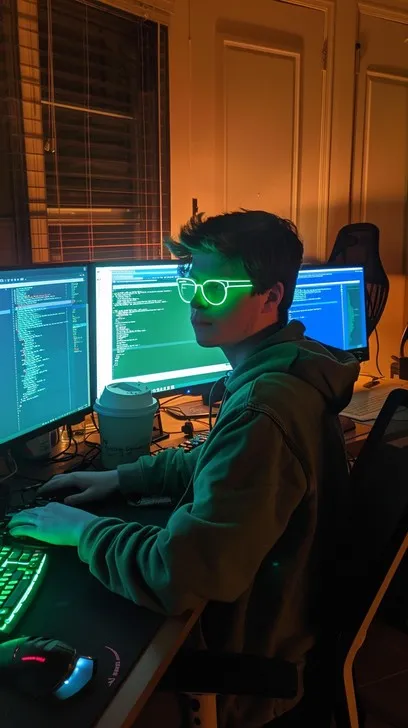
Photo: developer coding alone at night dark room glowing monitor, via images.stockcake.com
You've been staring at the same stack trace since 2 PM. You've Googled every variation of the error message. You've asked in three different Slack channels. Nothing. Then, somewhere around 3 AM, with a half-empty mug of coffee going cold beside your keyboard, something clicks. You find it. The bug — that maddening, logic-defying bug — just gives up.
If you've spent any real time coding after midnight, you know this feeling. And if you've ever wondered whether you're just imagining things, you're not. There's a legitimate neurological reason why some of your best debugging happens when everyone else is dead asleep.
Your Brain on Quiet
Here's the thing about daytime work: your brain is constantly context-switching. Slack pings, email threads, a coworker stopping by your desk, the ambient noise of a household or an open-plan office — all of it chips away at your ability to hold a complex problem in working memory. Debugging especially demands that you keep multiple variables, call stacks, and conditional branches active in your head simultaneously. Every interruption forces a mental reload.
At 3 AM, that noise disappears. The house is quiet. Your phone isn't buzzing. Nobody needs anything from you. Your brain gets to actually settle into the problem.
Neuroscientists call this the default mode network — a set of brain regions that activate when you're not being bombarded by external stimuli. It's associated with creative thinking, pattern recognition, and making unexpected connections between ideas. When you're under pressure during a standup or racing a deadline at noon, this network tends to go quiet. But in the late-night stillness, it fires up. That's when you start seeing the bug not just as a line of broken code, but as a symptom of a broader architectural misstep you hadn't noticed before.
The Flow State Nobody Talks About
Flow state gets a lot of press in productivity circles, and for good reason. It's that zone where time disappears and output just... happens. Psychologist Mihaly Csikszentmihalyi described it as the optimal experience of complete absorption in a challenging task. Most productivity content focuses on achieving flow during business hours. But late-night developers have known for years that after midnight is prime flow territory.
The conditions for flow are specific: the task has to be challenging but not overwhelming, distractions have to be minimal, and you need a clear sense of what you're trying to accomplish. The quiet hours check all three boxes naturally. You're not fighting for the mental bandwidth to stay in the zone — the zone just shows up.
Marcus T., a full-stack developer based in Austin, Texas, puts it this way: "During the day I'm in meetings, reviewing PRs, answering questions. My brain is always in 'respond' mode. But after 11 PM, I flip into 'build' mode. I've solved more architectural problems between midnight and 2 AM than I have in any two-week sprint."
That's not a coincidence. It's a workflow.
The Neurochemistry of Night Owls
There's also something worth understanding about chronobiology here. Not everyone's circadian rhythm is built the same way. A significant chunk of the population — researchers estimate somewhere between 20 and 25 percent — are natural "evening types," meaning their cognitive peak genuinely occurs later in the day. For these folks, forcing a 9-to-5 schedule isn't just uncomfortable; it's actively working against their brain chemistry.
Even for those who aren't natural night owls, the late-night environment creates conditions that mimic a second wind. Cortisol — the stress hormone that spikes in the morning and drives that anxious, reactive energy — drops off significantly in the hours before midnight. With less cortisol in the mix, many developers report feeling calmer, more methodical, and better able to sit with ambiguity. And debugging is all about sitting with ambiguity.
Adriana V., a frontend engineer in Chicago, describes it this way: "During the day, when I hit a wall, I panic a little. I feel like I'm behind. But at night, hitting a wall just feels like... a puzzle. I'm not stressed about it. I just start pulling threads."
That emotional regulation difference isn't trivial. Anxiety narrows thinking. Calm expands it.
The Practical Side: Making Late-Night Debugging Work For You
None of this means you should just stay up until dawn every night and hope for the best. The late-night edge is real, but it has limits — and burning out is a very fast way to lose it entirely. Here are a few ways to actually harness this window without destroying yourself in the process.
Timebox your late sessions. Decide before you sit down how long you're going to work. Two hours of focused late-night debugging is almost always more productive than five hours of diminishing-returns exhaustion. Set an alarm if you have to.
Start your late session with a brain dump. Before you dive back into the code, spend five minutes writing down everything you already know about the bug. What you've tried, what the error says, what you suspect. Externalizing the problem frees up working memory and often reveals a new angle you hadn't considered.
Use the quiet for reading, not just writing. Late-night sessions are great for actually reading documentation, tracing through source code, or studying how a library works under the hood. The stillness makes it easier to absorb dense technical material.
Protect your sleep debt. This is the one nobody wants to hear, but it matters. Consistently cutting sleep to code more doesn't make you more productive — it makes you worse at debugging within a week. If you're doing late-night sessions regularly, shift your schedule to compensate rather than just stacking them on top of a full day.
The 3 AM Advantage Is Real — Use It Wisely
There's a reason so much legendary software has been built in the quiet hours. It's not just romanticism or developer folklore. The cognitive conditions that exist after midnight — reduced distraction, activated default mode thinking, lower cortisol, natural flow state — are genuinely powerful. The developers who understand this and build intentional late-night workflows around it have a real edge.
So the next time a bug has you stumped at 5 PM, don't force it. Step away. Come back at midnight with fresh eyes, a quiet house, and the knowledge that your brain is about to do its best work. The bug doesn't stand a chance.